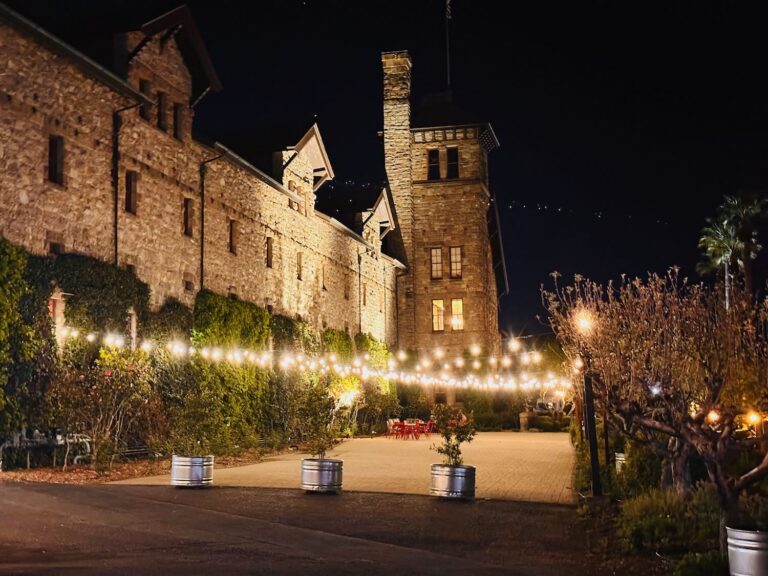
The Vines of St. Helena: Chase Cellars

Originally published in the St. Helena Star |
1. When was your winery founded?
“1998.”
2. Why did you choose to be in the St. Helena American Viticultural Area (AVA)?
“Our family, the Bourns, purchased our property in 1872 and we’ve been fortunate to call it home ever since. We were literally ‘grandfathered in.’ Our cousins also own pieces of this same 1872 vineyard purchase. Jointly, the property is now known as the Hayne Vineyard, after our great-grandparents, William Alston and Maud Bourn Hayne.”
3. Who is owner? Who is winemaker? Who is vineyard manager?
“Chase Cellars is owned by Katie Hayne Simpson and her brother, Mike Simpson — both are fifth-generation owners of the Hayne vineyard. Since 2014, Russell Bevan has been our winemaker. Rios Farming Co. has been doing an amazing job with the vineyard management.”
4. How many acres do you farm in the St. Helena AVA? How does that break down into types of varietals/acre?
“We farm just under 12 acres: 7 acres of Old Vine Zinfandel (70% are 120+ years old, 20% 35-year-old interplants and 10% new interplants field grafted in 2019) and 3.6 acres of Cabernet Sauvignon.”
5. Do you farm sustainably/organically/biodynamically?
“Sustainably farmed.”
6. Please describe your vineyards: soil; exposure; narrow spacing; type of trellising; irrigation/dry farmed, etc.
“Our vineyard is planted in gravelly loam and cortina soils at the foot of the Mayacamas Mountain in the southwestern corner of St. Helena. The Zinfandel, originally planted around 1903, is all head-trained and field-grafted on St. George rootstock. The spacing is a massive 8 by 11 feet, giving us only about 490 vines per acre (most vineyards planted today are 1,200 to 2,700 vines per acre). The vineyard has historically been dry-farmed, but in the course of inter-planting (replacing old vines as they die), we introduced drip line irrigation just to get the new plantings established. As the droughts and heatwaves have continued to hit the valley, we decided to irrigate the entire vineyard just last year. Giving the 120-year-old vines some water when nature can’t has really proven to support their health and vigor. In 2019 we planted 3.6 acres of Clone 7 Cabernet Sauvignon on 110R rootstock. 2023 marked our third year of production. The Cabernet spacing is 5 by 7 feet (1,230 vines an acre) and cane pruned to maximize quality and longevity.”
7. Wineries today try to differentiate the visitor experience. What’s unique about visiting Chase Cellars?
“Our experience allows visitors to walk amongst our more than 120-year-old Zinfandel vines, taste fruit (when it’s on vine) and learn about the history of the valley, our family, and the evolution of farming throughout Napa’s history.”
8. What might surprise people to learn about you/your winery/your operation?
“Most people are surprised to see how old our Zinfandel vines are and how much they can still produce after all this time! They enjoy learning about head-trained vines vs. the more modern planting on wire trellis. Our guests are often amazed at the 151-year history of continuous family ownership and that our family-founded Greystone Cellars — the first co-op winery in the valley back in 1888, which is now home to the Culinary Institute of America, Greystone.”
9. What is special about the St. Helena AVA in your opinion? Is it misunderstood? What do you wish visitors knew about it which perhaps they don’t?
“St. Helena is unique as it’s the bottle neck of the valley and predominantly comprised of alluvial fans, which create hillside textures with the richness and ripening of fruit from the valley floor. We also have one of the largest diurnal temperature shifts (hot/cold) in Napa that creates contrast in the wines in flavor and texture that make them stand out from the crowd! It’s a quiet gem of a town full of heart and history.
7. Wineries today try to differentiate the visitor experience. What’s unique about visiting your winery/tasting room?
“Our goal has always been to keep hospitality at the forefront of the guest experience. As a small winery, we strive to create a warm and welcoming environment where guests feel at home. Tastings are hosted one-on-one with a member of our team and offer guests an opportunity to taste limited-production wines that can’t be found outside the winery.”
8. What might surprise people to learn about you/your winery/your operation?
“We are often asked about the inspiration behind the winery’s name. Few people know that Thomas was a literature major in college and has an affinity for classic American poetry. Mending Wall takes its namesake from the famous Robert Frost poem, symbolizing the idea of collaboration and unity in winemaking.”
9. What is special about the St. Helena AVA in your opinion? Is it misunderstood? What do you wish visitors knew about it which perhaps they don’t?
“Located mid-valley at the most narrow point, vineyards in the St. Helena AVA experience warmer days and less diurnal shift than other parts of the valley. This factor, in combination with the wide variation of soil types created by runoff from the Vaca and Mayacamas mountains, offers vintners the chance to produce uniquely balanced, fruit-forward wines. Factoid: White Sulphur Springs Resort was the primary draw to St. Helena in the 1800s as the first resort in the state of California. Also, there is a tremendous amount of history waiting to be discovered in such a small area — Krug, Martini, Greystone/Christian Brothers, Beringer … “
10. What’s your favorite place in St. Helena to eat, drink or relax?
“Market, Farmstead and Brasswood — the cheese. Enough said.”
(This is part of a series of Q&A articles highlighting winemakers and grape growers in the St. Helena Appellation.)
On the Vines: Meet the grape growers and winemakers of St. Helena
Learn about the St. Helena wine business from the grape growers and winemakers who develop some of the best wines in Napa Valley … and the world.

Follow us on Social:

Author: Appellation Winery
Testing testing testing